
Performance Improvement Plans (PIPs)
What a PIP Actually Is
A Performance Improvement Plan is a formal, documented plan designed to help an underperforming employee get back on track. That's it. It's not a death sentence. It's not a "pack your bags" notice. It's not HR's way of building a paper trail to fire you.
At least, it shouldn't be.
The reality is that PIPs have a terrible reputation, and some of that reputation is earned. Too many managers use them as a formality before termination — a box to check so legal is happy. When that happens, everyone loses. The person on the PIP knows it's performative. The team knows it's performative. And the manager has wasted weeks pretending to care about improvement while the outcome was already decided.
But when a PIP is used honestly — when you genuinely want someone to succeed and you're giving them a clear, structured path to do it — it can be one of the most powerful tools you have. I've seen engineers go through a PIP and come out the other side as strong, reliable contributors. It happens. Not always, but enough that you should take every PIP seriously.
A PIP is a formal document that includes:
- A clear statement of where the person's performance is falling short
- Specific, measurable goals they need to hit
- A defined timeline to hit those goals
- The support you'll provide
- The consequences if they don't meet the goals
It's a contract of sorts. "Here's where you are. Here's where you need to be. Here's the plan. Here's what happens if we can't close the gap." Everyone signs it. HR has a copy. There's no ambiguity.
When to Use a PIP
A PIP should never be your first move. Not your second. Not your third. It comes after you've exhausted informal approaches and documented that you've done so.
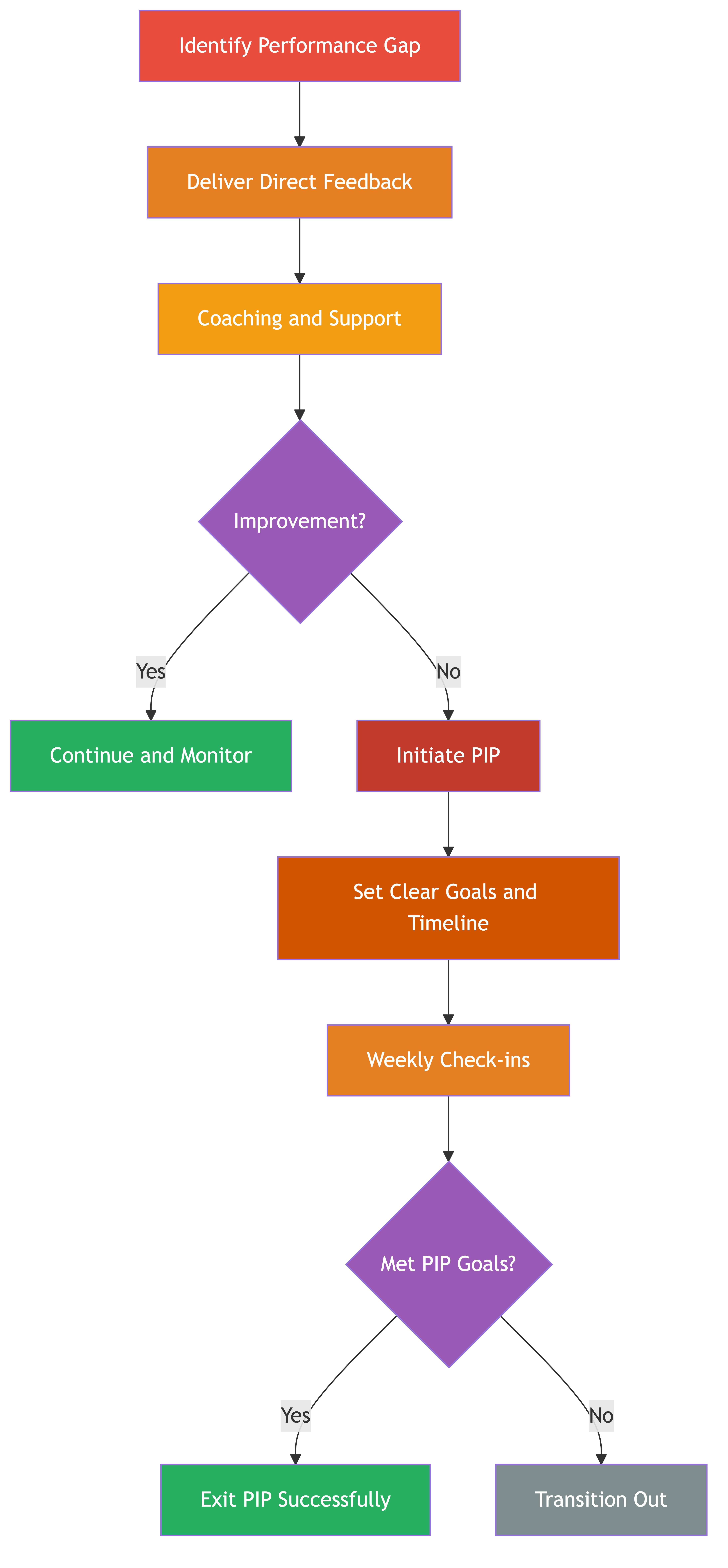
Here's the typical path that should precede a PIP:
1. Direct feedback. You've told the person, clearly and specifically, what isn't working. Not hints. Not "maybe consider doing X differently." Actual, direct feedback. "Your last three pull requests had significant bugs that made it to staging. That's below the bar for this role."
2. A coaching period. You've worked with them on the issue. You've had multiple conversations. You've offered guidance, resources, pairing sessions — whatever makes sense. This usually spans weeks to months.
3. Documentation of all of the above. You have notes from your 1:1s. You have written feedback you've shared. You have timestamps. You can show, on paper, that you've been working on this for a while and improvement hasn't happened.
Only then does a PIP become appropriate.
If you're reaching for a PIP after one bad quarter or one failed project, stop. That's not a performance problem — that's a bad moment. People have those. Coach through it.
If someone has been consistently underperforming for months, you've given repeated clear feedback, you've tried coaching, and nothing has changed — that's when a PIP enters the picture.
There are a few other scenarios where a PIP might not be the right tool:
- Behavioral issues (harassment, toxicity, policy violations) — these typically go straight to disciplinary action, not a PIP.
- Role misalignment — sometimes someone is in the wrong role entirely. A PIP won't fix that. A conversation about a role change might.
- Organizational change — if the job changed around them and they don't have the skills for the new version, that's a different conversation than underperformance.
PIP vs. Coaching
People sometimes confuse these, so let me be clear about the distinction.
Coaching is informal, ongoing, and part of your normal management practice. Every engineer on your team should be getting coaching in some form — through feedback in 1:1s, guidance on projects, stretch assignments, code reviews, whatever. Coaching is how you help good performers become great and how you help struggling performers improve before things become serious.
A PIP is formal, time-bound, and documented. It's a structured intervention with specific goals, a deadline, HR involvement, and stated consequences. It lives in a file somewhere. It has signatures on it.
Think of it as an escalation ladder:
- Informal feedback — "Hey, I noticed X. Let's talk about it." Happens in real time, in 1:1s, after incidents. No formal documentation needed, though you should keep notes.
- Coaching plan — "We've talked about this a few times, and I want to get more structured about it. Let's set some goals and check in weekly." Still informal, but you're both acknowledging this is an area that needs focused work. Document your conversations.
- Performance Improvement Plan — "We've been working on this for a while and I'm not seeing the improvement we need. I'm putting together a formal plan with HR. Here's what success looks like, here's the timeline, and here's what happens if we don't get there."
- Termination — "We've gone through the PIP process and the goals weren't met. We're going to part ways."
Each step should be a natural escalation from the one before it. If you skip straight from step 1 to step 3, you've moved too fast. If you're stuck on step 2 for a year, you've moved too slow.
How to Structure a PIP
A weak PIP is vague, subjective, and impossible to measure. A strong PIP is specific, fair, and crystal clear. Here's what goes into one.
The Core Components
1. Performance Summary
A clear, factual description of the performance gap. Not opinions, not feelings — observable behaviors and outcomes.
Bad: "You're not meeting expectations."
Good: "Over the past three months, four of your six shipped features required significant rework after code review. Two had production incidents within a week of deployment. Your peer average for rework is one in six. This pattern has persisted despite feedback given on [specific dates]."
See the difference? The second one is inarguable. It's data.
2. Specific, Measurable Goals
What does success look like? Be precise enough that both you and the employee can look at the goals at the end of the timeline and agree on whether they were met.
Bad: "Improve code quality."
Good: "Over the next 45 days, ship at least four features with no more than one requiring significant post-review rework. Zero P1 production incidents caused by your code. Complete the team's testing checklist for every PR."
3. Timeline
Typically 30 to 60 days. Shorter than 30 doesn't give enough time for real change. Longer than 60 and you're dragging things out in a way that's painful for everyone. Some companies default to 30, some to 60 — follow your organization's norms and talk to HR.
4. Check-in Cadence
Weekly at minimum. I'd recommend twice a week for the first two weeks, then weekly after that. These aren't optional meetings. They're documented touchpoints where you review progress, provide feedback, and adjust if needed.
5. Support Provided
What are you going to do to help them succeed? This might include:
- Pairing sessions with senior engineers
- Reduced scope or workload so they can focus
- Access to training or courses
- More frequent code review feedback
- Clearer specifications for their assignments
If you're not offering any support, you're not running a PIP — you're running a countdown clock.
6. Success Criteria
Restate the goals in clear pass/fail terms. "At the end of 45 days, if you have met goals 1, 2, and 3, the PIP will be closed and you'll return to normal performance status."
7. Consequences
Be explicit. "If the goals are not met by [date], we will move to termination." No one should be surprised by what happens at the end.
A Note on Fairness
The goals in a PIP should be achievable. They should represent the minimum acceptable bar for the role — not excellence, not stretch performance. You're asking: "Can this person do the basic job?" If your PIP goals are set at a level that a top performer would struggle to hit, you've rigged the game. Don't do that.
The PIP Conversation
This is one of the hardest conversations you'll have as a manager. How you deliver the PIP matters enormously — it sets the tone for the entire process.
Before the Meeting
- Have the PIP document finalized and reviewed by HR.
- Schedule enough time. At least 45 minutes. Don't squeeze this into 15 minutes before another meeting.
- Have the meeting in private. A meeting room, a video call with cameras on — whatever gives the person privacy and your full attention.
- Have HR present or available. Some companies require an HR representative in the room; others don't. Either way, HR should know the meeting is happening.
During the Meeting
Be direct. Don't spend ten minutes on small talk and then ambush them. Start with what the meeting is about.
"I want to talk with you about your performance. This is a serious conversation, and I want to be straightforward with you."
Be specific. Walk through the performance gap. Reference the feedback you've already given. Connect the dots.
"We've talked multiple times about code quality — on [date], [date], and [date]. I've shared specific feedback on [examples]. Despite those conversations, I'm still seeing the same patterns. That's why we're here."
Be compassionate. This is a human being who is hearing that their job is at risk. They might be scared, angry, defensive, or shut down. That's normal. Don't match their emotion. Stay steady.
"I want to be clear: I want you to succeed. This plan isn't designed to push you out. It's designed to give you a clear path to get back on track. But I also have to be honest that if things don't improve, we'll need to make a change."
Walk through the PIP document together. Go through every section. Make sure they understand the goals, the timeline, the check-in schedule, and the consequences. Ask if they have questions. Give them time to process.
Don't argue about the past. They may want to relitigate previous feedback or dispute specific examples. Listen, but don't get pulled into a debate. The decision to start the PIP has been made. The conversation is about moving forward.
"I hear your perspective, and I understand you see it differently. We can talk about that more in our check-ins. Right now, I want to make sure you understand the plan and what success looks like going forward."
End with genuine support.
"I'm going to be here to help you through this. We'll meet [cadence], and I'll make sure you have what you need. I believe you can do this."
After the Meeting
Give them space. They'll need time to process. Follow up in writing with a summary of the conversation and a copy of the PIP document. Let them know they can reach out to HR with questions.
Documentation
If there's one thing you take from this entire guide, let it be this: document everything. Documentation is what protects the employee, protects you, and protects the company. Without it, a PIP process is a he-said-she-said nightmare.
What to Document
- Every piece of feedback you've given before the PIP started — dates, content, how it was delivered.
- The coaching efforts you made — what you tried, when you tried it, what the outcome was.
- The PIP document itself — signed by the employee, the manager, and HR.
- Every check-in during the PIP — date, what was discussed, progress against goals, any feedback given, any adjustments made. Send a written summary after each check-in.
- The outcome — whether goals were met, partially met, or not met. The specific evidence for your assessment.
How to Document
Keep it factual. Keep it specific. Keep it professional.
Bad documentation: "Had a 1:1. Discussed performance. They seemed unmotivated."
Good documentation: "1:1 on March 10. Reviewed PIP goal #2 (code quality). Two of three PRs submitted this week passed review without significant rework. One required changes to error handling, which we discussed. Provided feedback on testing practices and shared the team's testing guide. Employee acknowledged the feedback and committed to reviewing the guide before next week's check-in."
HR Involvement
HR should be involved from the moment you start thinking about a PIP — not after you've written one. They'll help you:
- Ensure the PIP is legally sound
- Make sure you've documented enough coaching history
- Review the goals for fairness and measurability
- Navigate the process if the PIP leads to termination
- Handle any employee relations issues that arise
If you're running a PIP without HR, you're taking on unnecessary risk. Don't do it.
Supporting Someone on a PIP
This is where your integrity as a manager gets tested.
If you put someone on a PIP, you need to genuinely want them to succeed. If you've already decided the outcome — if you're just going through the motions before firing them — you are being dishonest. That's not management; that's theater. And people always see through it.
Here's what genuine support looks like during a PIP:
Remove blockers. If their workload is too high to focus on improvement, reduce it. If they need a different project to demonstrate their skills, give them one. If there's a team dynamic getting in the way, address it.
Be available. Don't just wait for the scheduled check-ins. Be responsive. Answer questions. Provide feedback in real time, not just at weekly reviews.
Give clear, immediate feedback. During a PIP, the feedback loop should be tighter than normal. If you see something going well, say so immediately. If you see a problem, flag it the same day. Don't let issues accumulate until the next check-in.
Adjust the plan if needed. Sometimes a goal turns out to be poorly defined, or circumstances change (a reorg, a project cancellation). Be willing to adjust the PIP — in consultation with HR — if something genuinely changes. This doesn't mean lowering the bar. It means keeping the plan relevant.
Check in on them as a person. A PIP is stressful. It affects sleep, confidence, relationships. You don't need to be their therapist, but you can acknowledge the difficulty. "I know this is a tough period. How are you doing?" goes a long way.
Celebrate progress. When they hit a milestone, say so. When a check-in goes well, acknowledge it. Positive reinforcement during a PIP is just as important as corrective feedback.
When the PIP Succeeds
This is the outcome you should be hoping for. Someone was struggling, you gave them structure and support, and they turned it around. That's a win for everyone.
But closing a successful PIP isn't the end — it's a transition. Here's how to handle it well.
Formally close the PIP. Meet with the employee (and HR, if appropriate) to officially confirm that the goals have been met and the PIP is closed. Put it in writing.
Celebrate the improvement. Not publicly — the PIP itself should remain confidential — but between you and the employee. Acknowledge the effort it took. "You worked really hard on this, and it shows. I'm glad we're here."
Rebuild trust. The PIP process can damage the relationship between you and the employee. They may feel resentful, embarrassed, or guarded. That's understandable. Give it time. Be consistent. Show through your actions — not just your words — that you see them as a full member of the team.
Don't hold it against them. This is critical. A closed PIP is a closed chapter. When promotion conversations come up, when project assignments are made, when performance reviews roll around — you evaluate them on their current performance, not on the fact that they were once on a PIP. If six months later they're performing at a high level, treat them like anyone else performing at that level.
Monitor without hovering. It's natural to keep a closer eye on someone who was recently on a PIP. That's fine. But don't micromanage them or treat every small mistake as a sign that they're backsliding. Give them room to be human.
When the PIP Fails
Sometimes, despite genuine effort from both sides, the person doesn't meet the goals. Sometimes there's no effort from their side at all. Either way, you arrive at the end of the timeline with unmet objectives, and now you have to act.
This is the hardest part of management. Letting someone go is never easy, and it shouldn't be. If it feels routine to you, something has gone wrong.
The Exit Conversation
- Work with HR. The termination decision should be made jointly with HR. They'll guide you on process, legal requirements, timing, and logistics (final pay, benefits, equipment return, access revocation).
- Be direct and brief. The person knows the PIP goals. They know whether they met them. Don't drag it out. "We've reached the end of the PIP period, and unfortunately, the goals we set weren't met. As we discussed at the start of the process, we're going to part ways."
- Don't re-litigate. They may argue. They may provide reasons or excuses. Listen briefly, but don't engage in a debate. The decision is made.
- Treat them with dignity. This is someone's livelihood. Be kind. Thank them for their contributions. Offer what you can — a reference for the skills they do have, information about severance, career transition resources. Let them leave with their dignity intact.
Legal Considerations
I'm not a lawyer, and you're not either. That's why HR and legal should be involved. A few general principles:
- A well-documented PIP process protects the company from wrongful termination claims. This is why documentation matters so much.
- Make sure the PIP goals were fair, measurable, and achievable. If they weren't, you're on shaky ground.
- Ensure you've been consistent. If you've had other employees with similar performance issues and you didn't put them on a PIP, that's a problem.
- Never put someone on a PIP for reasons that are actually about their protected characteristics (age, gender, race, disability, etc.). If the real issue isn't performance, a PIP is the wrong tool and potentially illegal.
Impact on the Team
Here's something managers often underestimate: the team is watching. They may not know the details of the PIP, and they shouldn't — PIPs are confidential. But they know something is going on. They can feel the tension. They notice the extra meetings. They see the change in someone's demeanor.
What to Communicate
You can't discuss the PIP itself with the team. But you can:
- Reinforce team standards. Without naming the individual, remind the team what good performance looks like. Talk about quality expectations, collaboration norms, and accountability in general terms.
- Address workload changes. If the person on the PIP has a reduced workload, the team may notice. Redistribute work fairly and explain it in neutral terms. "I'm adjusting some assignments to make sure we're set up for success this quarter."
- Be present. During a PIP period, spend more time with the whole team, not just the person on the PIP. Don't let the PIP consume all your management energy.
If the Person Leaves
When someone exits — whether through PIP failure or resignation during the PIP — the team will feel it. Some may be relieved (especially if the underperformance was visible and affecting them). Some may be anxious ("Am I next?"). Some may feel sad or conflicted.
Address the departure with the team promptly and professionally. You can't share the reason, but you can say: "As of today, [name] is no longer on the team. I know transitions are hard. I want you to know that I'm here if you want to talk. Here's how we're going to handle their work in the short term."
Then follow through. Backfill the role. Redistribute work fairly. Don't let the remaining team members absorb an unsustainable workload because of a gap.
Real-World Scenarios
Scenario 1: The PIP That Turned Someone Around
Maya was a mid-level engineer who had been strong for two years and then started declining. Her code quality dropped. She missed deadlines. She seemed disengaged in meetings. Her manager, Priya, gave feedback multiple times over two months, then tried a coaching plan with weekly check-ins and specific goals. After six more weeks with no improvement, Priya initiated a PIP.
The PIP had clear goals: ship two features with zero post-review rework, complete all sprint commitments for three consecutive sprints, and actively participate in design reviews (at least two substantive comments per review).
During the PIP, Priya learned that Maya was dealing with burnout after a brutal on-call rotation that had lasted for months. Maya hadn't felt comfortable raising it. With the structure of the PIP — and Priya's genuine support — Maya got real about what was going on. Priya removed her from on-call, adjusted her workload, and pointed her toward the company's mental health resources.
Maya met all three PIP goals by week five of a six-week plan. Priya closed the PIP early. A year later, Maya was promoted to senior engineer.
The lesson: sometimes underperformance has a root cause that only surfaces under pressure. A well-run PIP can create the space for honesty.
Scenario 2: The PIP That Led to Exit
Carlos was a senior engineer who consistently delivered below his level. His system designs needed heavy rework from staff engineers. His code reviews were superficial. When given feedback, he agreed in the moment but nothing changed. His manager, Derek, spent three months coaching him with documented feedback in every 1:1, paired him with a principal engineer for mentorship, and gave him successively clearer expectations.
Nothing improved. Derek initiated a PIP with 45-day timeline: lead one design review end-to-end with no major revisions needed, reduce PR review turnaround to under 24 hours, and provide substantive (not rubber-stamp) code reviews on at least 70% of team PRs.
Derek checked in twice a week. He provided examples of good code reviews. He sat in on Carlos's design review prep. Despite all of this, Carlos met only one of three goals by the end of the 45 days.
Derek and HR moved to termination. The conversation was compassionate and brief. Derek thanked Carlos for his contributions and offered to be a reference for roles that might be a better fit. Carlos was upset but not surprised — the process had been transparent from the start.
The lesson: sometimes the fit is wrong, and a PIP confirms what coaching already suggested. When it's handled with transparency and respect, even the person leaving can acknowledge the process was fair.
Scenario 3: The Dishonest PIP
Anika was a solid engineer who clashed with her new manager, Tom. Tom found Anika's communication style abrasive and her pushback in meetings annoying. Rather than addressing the interpersonal issue directly, Tom decided Anika was a "performance problem" and started building a case. He nitpicked her code reviews, set PIP goals that were significantly harder than what he expected from others on the team, and offered no real support during the process.
Anika recognized what was happening. She went to HR. HR investigated and found that Tom had set goals for Anika that no one else on the team was held to, had no documented coaching trail before the PIP, and had made comments to another manager about "needing to get rid of" Anika weeks before the PIP started.
HR shut down the PIP. Tom faced consequences for misusing the process. Anika transferred to another team, where she thrived.
The lesson: a PIP used as a weapon destroys trust — not just with the person on the PIP, but with everyone who finds out what happened. And people always find out. If your real issue is a personality conflict, address it as a personality conflict. Don't dress it up as a performance problem.
Common Mistakes
These are the patterns I see again and again. If you find yourself doing any of these, stop and recalibrate.
Using a PIP as the first resort. If you haven't given clear, documented feedback and tried coaching first, you're not ready for a PIP. A PIP without a coaching trail looks like an ambush — because it is one.
Setting vague or unmeasurable goals. "Improve your attitude" is not a PIP goal. "Be more proactive" is not a PIP goal. If you can't point to a specific, observable outcome and say "this was met" or "this was not met," the goal isn't good enough.
Providing no actual support. A PIP without support is a countdown clock. If you're not removing blockers, offering resources, checking in frequently, and genuinely helping — you're just documenting a slow firing.
Predetermining the outcome. If you've already decided to fire someone before the PIP starts, don't pretend. Either give them a real chance or have the honest conversation that it's not working out. A fake PIP wastes everyone's time and erodes your credibility.
Skipping HR involvement. HR exists precisely for situations like this. They protect the employee, they protect the company, and they protect you. Trying to run a PIP solo is how managers end up in legal trouble.
Not documenting the coaching trail. You can't prove you tried to help if you didn't write it down. "We talked about it a bunch of times" doesn't hold up in an HR review or a legal proceeding. Dates, content, outcomes — write it all down.
Inconsistent application. If two people have similar performance problems and you PIP one but not the other, you've got an equity problem. Be consistent in your standards and your process.
Dragging it out. Once a PIP concludes and goals aren't met, act. Don't extend the PIP for another 30 days because you feel bad. That's not compassion — it's avoidance. And it's worse for the person, who spends another month in limbo.
Forgetting about the rest of the team. While you're focused on the PIP, your other reports still need you. Don't let one person's situation consume all your management bandwidth.
Business Value
Performance Improvement Plans aren't just an HR requirement or a legal safeguard. When done right, they create real, measurable business value.
Retention of recoverable talent. Hiring is expensive. Onboarding is slow. When a PIP successfully turns someone around, you've saved the company the six-to-twelve months and significant cost of replacing that person. You've also preserved institutional knowledge that walks out the door with every departure.
Team performance and morale. Unaddressed underperformance is toxic. It demoralizes high performers who are picking up the slack. It signals that standards don't matter. A well-run PIP — whether it succeeds or fails — tells the team that you take performance seriously and that you handle it fairly. That raises the bar for everyone.
Reduced legal and compliance risk. A documented, fair PIP process dramatically reduces the risk of wrongful termination claims. Every dollar not spent on litigation is a dollar better spent elsewhere.
Manager development. Running a PIP well forces you to be a better manager. It sharpens your feedback skills, your documentation habits, your ability to set clear expectations, and your empathy. These skills don't just help during PIPs — they make you better at managing everyone.
Organizational learning. When you see patterns in PIP data — certain roles, certain teams, certain managers showing up repeatedly — that's signal. It tells the organization where hiring is off, where onboarding is failing, where management needs support. One PIP is an individual situation. A pattern of PIPs is an organizational problem worth solving.
Cultural clarity. A transparent, fair PIP process is one of the ways an organization defines its culture. It says: "We have standards. We hold people to them. We help people meet them. And if it doesn't work out, we handle it with respect." That's a culture good engineers want to work in.
The bottom line: a PIP process that is structured, fair, well-documented, and genuinely supportive is not overhead. It's infrastructure. It protects people, improves teams, and makes the organization more effective. Skipping it, faking it, or doing it poorly costs more in the long run — in turnover, in morale, in trust, and sometimes in legal fees.
Final Thought
A PIP is one of the highest-stakes tools in your management toolkit. Used well, it can save someone's career. Used poorly, it can destroy trust, invite legal risk, and damage your credibility as a leader.
The guiding principle is simple: be honest. If you genuinely want the person to succeed, build a plan that gives them a real chance and support them through it. If you've already decided it's over, have the courage to say so instead of hiding behind a process.
Your people deserve that honesty. And frankly, so do you.
Common Pitfalls
- Using a PIP as the first resort. Jumping to a formal PIP without first giving clear, documented feedback and trying coaching makes the process feel like an ambush and undermines its credibility as a genuine improvement tool.
- Setting vague or unmeasurable goals. Goals like "improve your attitude" or "be more proactive" are not PIP goals. If you cannot objectively determine whether the goal was met at the end of the timeline, the PIP is set up to fail — and to create legal risk.
- Predetermining the outcome. If you have already decided to fire someone before the PIP starts, going through the motions is dishonest theater. It wastes weeks, erodes your credibility, and people always see through it.
- Providing no actual support during the PIP. A PIP without reduced scope, pairing sessions, frequent check-ins, or other genuine support is not an improvement plan — it is a countdown clock that signals you were never serious about the person succeeding.
- Skipping HR involvement. Running a PIP without HR creates unnecessary legal risk, removes a safeguard for both the employee and the manager, and can result in a process that does not hold up under scrutiny.
- Dragging out the process after goals are not met. Extending a failed PIP for another 30 days out of discomfort rather than acting on the outcome is not compassion — it prolongs limbo for the employee and delays resolution for the team.
Key Takeaways
- A PIP is a formal, documented plan designed to help someone improve — not a death sentence or a box-checking exercise before termination. When used honestly, it can save careers.
- PIPs should only come after clear feedback, a coaching period, and documentation of all prior efforts. They are an escalation, not a starting point.
- Strong PIPs have specific, measurable goals tied to the minimum acceptable bar for the role, a defined timeline of 30-60 days, regular check-ins, explicit support commitments, and clear consequences.
- How you deliver the PIP conversation sets the tone for the entire process. Be direct, specific, compassionate, and genuine about wanting the person to succeed.
- Documentation is essential at every stage — before, during, and after the PIP. It protects the employee, the manager, and the company.
- When a PIP succeeds, formally close it, celebrate the improvement, and never hold it against the person going forward. When it fails, act decisively with dignity and respect.
- The team is always watching. A well-run PIP — whether it succeeds or fails — signals that you take performance seriously and handle it fairly. A poorly run PIP damages trust across the entire team.
- PIPs are not just an HR requirement. They develop your management skills, surface organizational patterns, and define your team's culture of accountability and support.