
Stakeholder Management at Scale
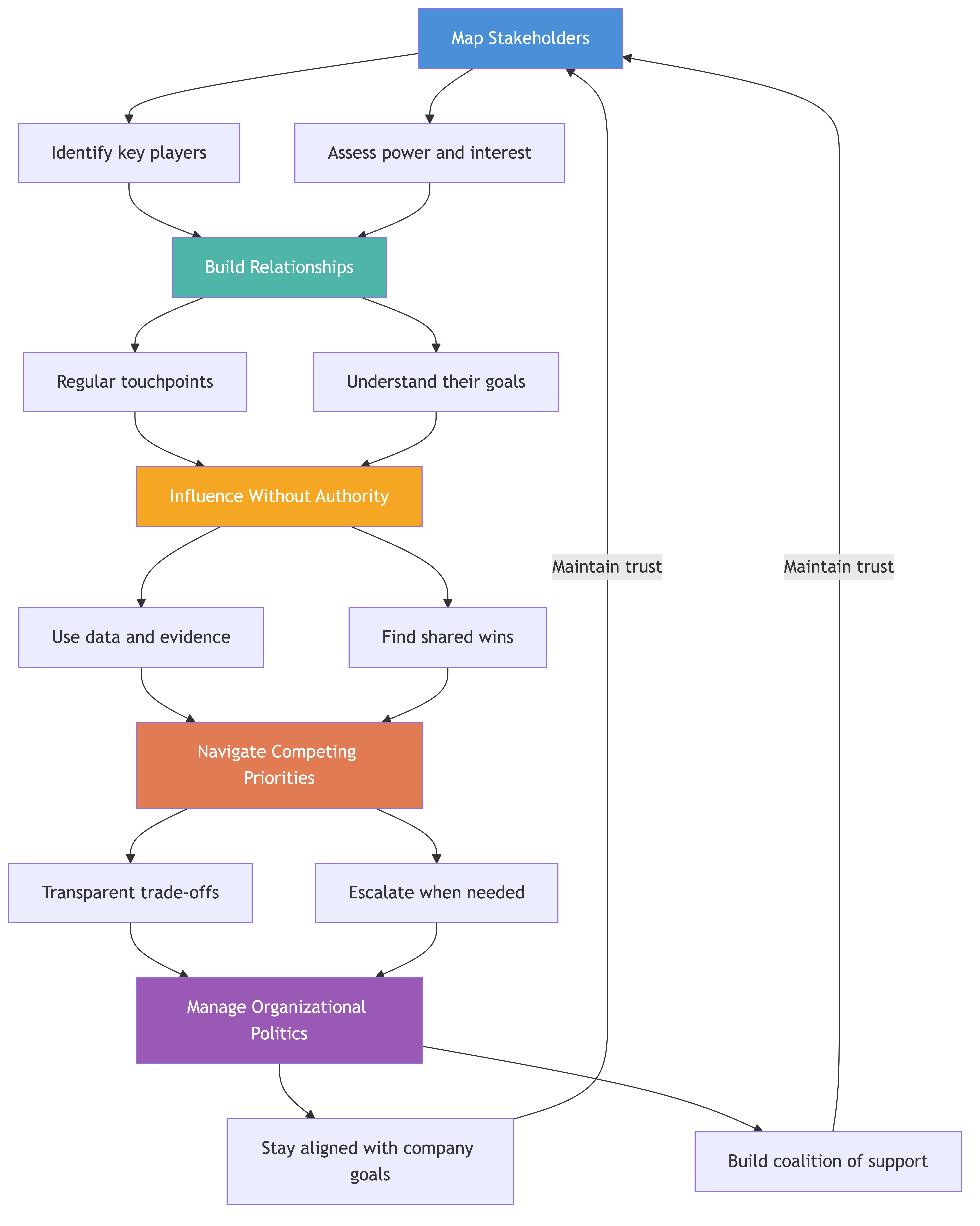
As a tech lead, your stakeholders were mostly your team and maybe a product manager. As an engineering manager, the number of people who care about what your team does — and who have opinions about how you should do it — expands dramatically. Product managers, designers, business partners, other engineering managers, directors, VPs, customer success, sales, legal. Each of them has their own priorities, their own pressures, and their own definition of what "done" looks like.
Managing one stakeholder is a conversation. Managing ten is a system. And if you do not build that system intentionally, you will spend your entire week in alignment meetings, reacting to whoever screams loudest, and wondering why your team cannot get anything done.
Stakeholder management at scale is not about making everyone happy. That is impossible. It is about making sure the right people have the right information at the right time, and that your team's work is aligned with what actually matters for the business.
Broader Stakeholder Landscape
At the EM level, your stakeholder map looks something like this:
- Product management. They own the "what" and the "why." They are your closest partner and your most frequent collaborator. They have roadmap commitments, customer feedback, and business metrics they are trying to move.
- Design. They own the user experience. They care about quality, consistency, and usability. They often feel rushed by engineering timelines and frustrated when their designs get cut for scope.
- Business teams. Sales, marketing, customer success, operations. They are closest to the customer and the revenue. They surface urgent requests, escalations, and "the customer needs this yesterday" demands.
- Other engineering managers. Your peers. You share platform resources, have cross-team dependencies, and occasionally compete for the same headcount or priorities. These relationships are easy to neglect and expensive to neglect.
- Leadership. Directors, VPs, C-suite. They care about the big picture — strategy, budget, risk, talent. They set the context your team operates in and control the resources you receive.
Each of these groups speaks a different language, operates on a different timeline, and measures success differently. Your product manager thinks in quarterly OKRs. Your sales team thinks in deal cycles. Your VP thinks in annual strategy. Your designer thinks in user journeys. Your peer EM thinks in team capacity and technical debt.
Your job is to navigate all of these perspectives, find the overlaps, and turn them into a coherent plan your team can actually execute on. That is stakeholder management at scale.
Influence Without Authority
Here is a truth that takes most new EMs a while to internalize: you cannot mandate what other teams do. You cannot tell the platform team to prioritize your request. You cannot tell the product manager on another squad to delay their launch so you can use their engineer. You cannot tell a designer to simplify their spec because your team is short-staffed.
And yet, you need all of these things to happen regularly. So how do you get things done when you have no formal authority?
You influence.
Build relationships before you need them. The time to build a relationship with the platform team's EM is not when you need them to prioritize your request. It is three months earlier, when you can offer to help with something they care about. Influence is built on trust, and trust takes time. Invest early.
Bring data, not opinions. "I think we should prioritize X" is weak. "X is blocking three teams and costing us approximately 40 engineering hours per week" is strong. Data makes your case for you. It also depersonalizes the conversation — you are not asking for a favor, you are presenting a business problem.
Find shared goals. Most cross-team conflicts are not actually conflicts. They are misaligned incentives. If you can find a framing where both teams win, you do not need authority. You need a whiteboard. "If your team builds the shared auth service, my team can stop maintaining our custom auth, and we can both move faster on the features leadership wants."
Be reliable. Influence compounds over time. If you say you will do something, do it. If you commit to a timeline, hit it. If you cannot hit it, communicate early. People give influence to people they can count on. Every kept promise is a deposit in the trust bank. Every broken promise is a withdrawal.
Make it easy to say yes. When you need something from another team, do not show up with a vague request. Show up with a clear ask, the context for why it matters, the impact of not doing it, and ideally a proposal for how it could work. Remove friction. The easier you make it for someone to help you, the more likely they will.
Managing Product, Design, and Business
These are your three closest cross-functional partners, and each one requires a different approach.
Product Management
Product managers are measured on business outcomes — revenue, engagement, adoption, retention. They are under pressure from leadership to deliver on roadmap commitments and from customers to solve specific problems.
The best EM-PM relationships are genuine partnerships. You bring the "how" and the engineering perspective. They bring the "what" and the business perspective. Together, you make better decisions than either of you would alone.
Common friction points:
- PM wants to commit to a timeline before engineering has estimated.
- PM wants to add scope mid-sprint because a customer asked for it.
- PM does not understand why "simple" features take so long.
How to manage this:
- Include your PM in estimation and planning. Let them see the complexity firsthand rather than arguing about it after.
- Create a shared framework for scope changes. "We can add this, but here is what we drop. Your call."
- Invest time in educating your PM on technical concepts that affect their decisions. Not deep dives, but enough context to make informed tradeoffs.
Design
Designers are measured on user experience quality. They care about consistency, accessibility, polish, and delighting users. They often feel like engineering treats their work as optional or negotiable.
Common friction points:
- Engineering cuts design details for scope without consulting design.
- Design delivers specs that are expensive to implement without understanding the cost.
- Timelines do not account for design iteration.
How to manage this:
- Involve design early in technical discussions. If a design is going to be expensive to implement, they want to know early so they can find alternatives.
- Treat design specs with respect. If you need to cut something, discuss it with the designer first. Do not just ship a degraded version.
- Build a relationship with your designer outside of project work. Understand what they care about, what frustrates them, and what "good" looks like to them.
Business Teams
Sales, marketing, customer success — these teams are closest to the customer and the revenue. They surface requests that feel urgent because they are tied to real customers and real money.
Common friction points:
- "The customer needs this by Friday or we lose the deal."
- Business teams do not understand why engineering cannot "just add a button."
- Engineering feels like a service desk for sales requests.
How to manage this:
- Build a repeatable intake process. Business requests should go through product, not directly to engineering. If you do not have this, work with your PM to create it.
- Help business teams understand the queue. "Your request is important. Here is where it sits relative to the other things we are working on and why."
- When a request truly is urgent and important, respond quickly. Build the reputation that when you say something is a priority, it actually is, so when you say something is not, they trust your judgment.
Navigating Priorities
This is the hardest part of stakeholder management at scale. Everyone wants your team's time. Product has a roadmap. Sales has customer requests. The platform team needs you to migrate to a new API. Leadership wants a strategic initiative. Your team wants to pay down tech debt. And you have the capacity for maybe 60% of it.
You need a framework. Without one, you will prioritize based on whoever is loudest, most senior, or most recently in your Slack DMs. That is not a strategy. That is chaos.
Here is a framework that works:
Step 1: Score on three dimensions.
- Business impact. How much does this move the needle on revenue, cost, risk, or strategic position? Use rough estimates, not precision.
- Urgency. Is there a real deadline? A customer commitment? A compliance requirement? Or is it just "we want it soon"?
- Strategic alignment. Does this advance the company's stated priorities? Or is it a side quest?
Step 2: Make it visible.
Put your prioritized list somewhere everyone can see it. A shared document, a roadmap tool, a slide in your weekly update. Transparency is your best defense against "why are you not working on my thing?" Because they can see exactly what you are working on and why.
Step 3: Communicate tradeoffs, not just decisions.
Do not just say "we are not doing X this quarter." Say "we are not doing X this quarter because we are doing Y and Z, which have higher business impact. Here is the data. If the priority changes, let me know and we will re-evaluate."
This approach does three things. It shows your reasoning. It invites challenge with data rather than politics. And it gives stakeholders a path to escalate if they genuinely believe the priority is wrong.
Step 4: Re-evaluate regularly.
Priorities change. Markets shift. Customers churn. New opportunities appear. Review your priorities monthly or quarterly with your key stakeholders. Do not set-and-forget.
Organizational Politics
Let us talk about the uncomfortable thing. Politics exists in every organization. Pretending it does not exist does not make you noble. It makes you naive. And naive managers get outmaneuvered by managers who understand the landscape.
That said, there is a difference between navigating politics and being political. Navigating politics means understanding how decisions get made, who influences whom, and how to position your team's work effectively. Being political means manipulating, backstabbing, and optimizing for your own career at the expense of others.
Navigate. Do not manipulate.
Understand the decision-making landscape. Who actually makes the decisions that affect your team? It is not always who you think. Sometimes it is a VP. Sometimes it is a principal engineer. Sometimes it is a PM who has the CEO's ear. Know who the decision-makers and influencers are, and make sure they understand what your team does and why it matters.
Build alliances. Find the other EMs, PMs, and leaders who share your priorities or whose goals align with yours. Support their work publicly. Share credit generously. When you need their support, they will be there because you were there for them.
Protect your team. Your team should not have to navigate politics. That is your job. Shield them from organizational noise, conflicting priorities from different stakeholders, and political pressure. If a VP wants to pull one of your engineers for a pet project, you handle that conversation so your engineer does not have to.
Do not trash-talk. Ever. Not about other teams, not about other managers, not about leadership decisions you disagree with. It always gets back to them, and it always damages your credibility more than theirs. If you disagree with something, disagree directly and constructively with the person who can change it.
Pick your battles. You cannot fight every fight. Some things are worth spending political capital on. Others are not. Ask yourself: does this materially affect my team's ability to deliver? If yes, engage. If no, let it go.
Real-World Examples
Scenario 1: The EM Who Built Bridges
Sara managed a team that depended on a shared data platform maintained by another EM's team. Her team was constantly blocked waiting for data pipeline changes. The easy, ineffective move would have been to escalate to her director and complain about the other team.
Instead, Sara spent a month building a relationship with Marcus, the other EM. She learned that his team was understaffed and overwhelmed with requests from five different teams. She proposed a solution: her team would contribute engineers to the data platform for three weeks to build self-service tooling, so that her team (and others) could make simple pipeline changes without needing Marcus's team.
Marcus agreed. Sara's team invested three weeks but saved months of future blocking. Marcus looked good because his platform became self-service. Sara looked good because her team unblocked themselves. Both teams shipped faster. Leadership noticed.
The lesson: the best stakeholder management often looks like helping other people succeed.
Scenario 2: The EM Who Over-Committed
Jason wanted to be seen as a team player. When product asked for a major feature on an aggressive timeline, he said yes. When sales escalated a customer request, he said yes. When his VP asked if his team could also take on a migration project, he said yes.
By mid-quarter, his team was working on three major initiatives simultaneously, making progress on none of them. Engineers were context-switching constantly, morale was dropping, and deadlines were slipping across the board. Product was frustrated. Sales was frustrated. His VP was frustrated.
Jason's mistake was conflating "stakeholder management" with "saying yes to everyone." Effective stakeholder management means being clear about capacity, transparent about tradeoffs, and willing to say "we can do A or B this quarter, but not both. Which is more important?" That conversation is uncomfortable in the moment but builds far more trust than overpromising and underdelivering.
Scenario 3: The EM Who Ignored Politics
Mei was a strong technical EM who believed that good work speaks for itself. She did not invest in relationships with other EMs or with leadership beyond her direct manager. She did not attend optional leadership meetings. She did not share her team's wins broadly. She focused entirely on execution.
Her team shipped great work. But when budget season came, her team's headcount request was denied while a peer EM's team — whose output was arguably less impactful — got two new headcount. Why? Because the peer EM had spent the year building relationships with the VP and the finance team. They understood what the peer EM's team did and why it mattered. They barely knew what Mei's team did.
Mei learned a painful lesson: execution is necessary but not sufficient. If the people who control resources do not understand your team's impact, your team will be under-resourced regardless of how well they execute. Visibility is not vanity. It is a responsibility you owe your team.
Common Mistakes
Avoiding politics entirely. "I just want to focus on the work" is an understandable sentiment but a dangerous strategy. You do not have to be political, but you do have to understand the political landscape. Ignoring it does not make it go away. It makes you vulnerable to it.
Over-committing. Saying yes to every stakeholder request because you want to be helpful. This is a trap. Over-commitment leads to under-delivery, which destroys the trust you were trying to build by saying yes in the first place. A well-reasoned "not this quarter" builds more trust than a cheerful "yes" followed by a quiet miss.
Not building relationships proactively. Waiting until you need something from someone to start building the relationship. By then it is too late. Relationships take time to develop. Invest in them before you need them. Have coffee with peer EMs. Attend cross-functional meetings. Learn what other teams are working on. Be genuinely curious about their challenges.
Treating stakeholder management as a one-time activity. Setting priorities once and assuming everyone stays aligned. They do not. People forget. Priorities shift. New stakeholders join. You need to continuously communicate, re-align, and re-confirm.
Not establishing a single source of truth. When different stakeholders have different understandings of what your team is working on and why, you get conflicting expectations and constant re-litigation of decisions. Maintain a visible, shared prioritization that everyone can reference.
Optimizing for consensus. Trying to get every stakeholder to agree before making a decision. With enough stakeholders, consensus is impossible. Aim for clarity, not consensus. Make the decision, communicate the reasoning, and give people a path to escalate if they disagree.
Business Value
Stakeholder management at scale is directly tied to your team's ability to deliver impact. An EM who manages stakeholders well ensures their team works on the right things, has the cross-functional support they need, and operates with clear priorities. An EM who manages stakeholders poorly ends up with a team that is constantly context-switching, working on low-impact projects because someone important asked, and blocked by other teams who do not understand or care about their needs.
The numbers are straightforward. A well-aligned team that works on the highest-impact projects will deliver multiples more business value than a misaligned team of the same size. Stakeholder management is how you achieve that alignment.
Beyond team output, stakeholder management directly affects your ability to secure resources. Headcount, budget, tooling, executive attention — these are all finite resources allocated based on perceived impact and trust. EMs who manage stakeholders well are perceived as reliable, strategic, and high-impact. They get more resources. EMs who do not are perceived as execution-focused but strategically limited. They get less.
There is also a retention dimension. Engineers want to work on meaningful projects with clear direction. When stakeholder management fails, engineers feel the chaos — shifting priorities, unclear goals, work that gets thrown away because someone changed their mind. That drives attrition. Good stakeholder management creates the stable, purposeful environment that strong engineers want to stay in.
Finally, stakeholder management is the skill that scales your impact beyond your team. As an individual contributor, your impact was your code. As an EM, your impact is your team's output. But as an EM who manages stakeholders at scale, your impact extends to every team and function you collaborate with. You become a multiplier not just for your team, but for the organization.
Common Pitfalls
- Over-committing to every stakeholder request. Saying yes to everything because you want to be helpful is a trap. Over-commitment leads to under-delivery, which destroys the trust you were trying to build. A well-reasoned "not this quarter" builds more trust than a cheerful "yes" followed by a quiet miss.
- Avoiding organizational politics entirely. "I just want to focus on the work" is an understandable sentiment but a dangerous strategy. You do not have to be political, but you do have to understand how decisions get made, who influences whom, and how to position your team's work effectively.
- Not building relationships until you need something. Waiting until you need another team's help to start building the relationship means you are starting from zero trust at the moment you need maximum cooperation. Invest in relationships before you need them.
- Treating stakeholder alignment as a one-time activity. Setting priorities once and assuming everyone stays aligned ignores the reality that people forget, priorities shift, new stakeholders join, and contexts change. Continuous communication and re-alignment is required.
- Optimizing for consensus instead of clarity. With enough stakeholders, unanimous agreement is impossible. Trying to achieve it causes decision paralysis. Instead, aim for clear decisions with transparent reasoning and a path for those who disagree to escalate.
- Not establishing a visible, shared source of truth for priorities. When different stakeholders have different understandings of what your team is working on and why, you get conflicting expectations, constant re-litigation, and the loudest voice wins instead of the highest-impact work.
Key Takeaways
- As an EM, your stakeholder map expands to include product, design, business teams, peer EMs, and leadership — each speaking a different language, operating on a different timeline, and measuring success differently.
- Influence without authority is built through relationships, data, shared goals, reliability, and making it easy for others to say yes. Invest in these before you need to draw on them.
- Manage product, design, and business partnerships differently: co-own outcomes with PMs, involve designers early in trade-off conversations, and build a repeatable intake process so business requests flow through product rather than directly to engineering.
- Use a prioritization framework that scores on business impact, urgency, and strategic alignment — then make the prioritized list visible so everyone can see what your team is working on and why.
- Navigate organizational politics by understanding the decision-making landscape, building alliances, protecting your team from noise, never trash-talking, and picking your battles carefully.
- Shield your team from stakeholder complexity. Engineers should not have to navigate shifting priorities, conflicting demands, or political pressure — that is your job.
- Stakeholder management directly affects your ability to secure resources. EMs perceived as reliable, strategic, and high-impact get more headcount, budget, and autonomy. EMs who are invisible get less.
- The skill of stakeholder management at scale extends your impact beyond your team to every function you collaborate with, making you a multiplier for the entire organization.